

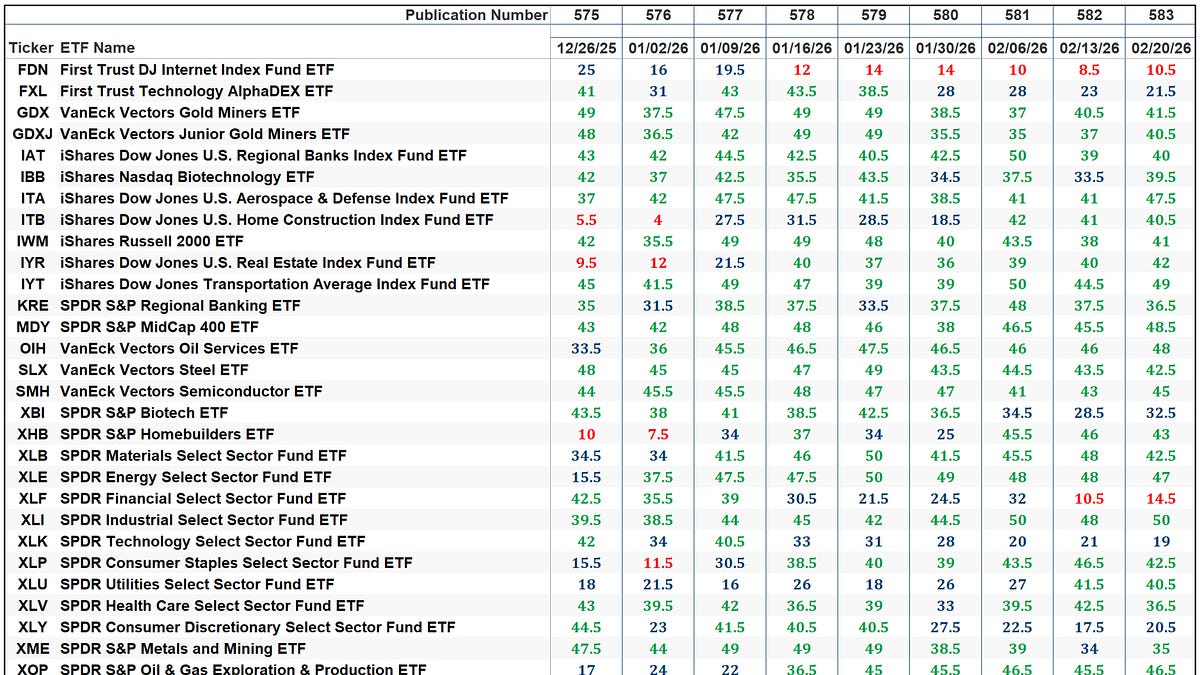
Welcome to The Market’s Compass US Index and Sector ETF Research, Week #577. As all the time it highlights the technical modifications of the 30 US Index and Sector ETFs that I monitor on a weekly foundation and usually publish each third week. Previous publications may be accessed by paid subscribers through The Market’s Compass Substack Weblog.
To know the methodology utilized in establishing the target U.S. Index and Sector ETF Particular person Technical Rankings go to the MC’s Technical Indicators web page at www.themarketscompass.com and go to “us etfs”. What follows is a Cliff Notes model* of the total clarification…
*The technical rating system is a quantitative strategy that makes use of a number of technical issues that embrace however will not be restricted to pattern, momentum, measurements of accumulation/distribution and relative energy of every particular person 30 U.S Index and Sector ETFs that may vary between 0 and 50. The Complete Technical Rating is the sum of the 30 US ETFs particular person Technical Rankings.
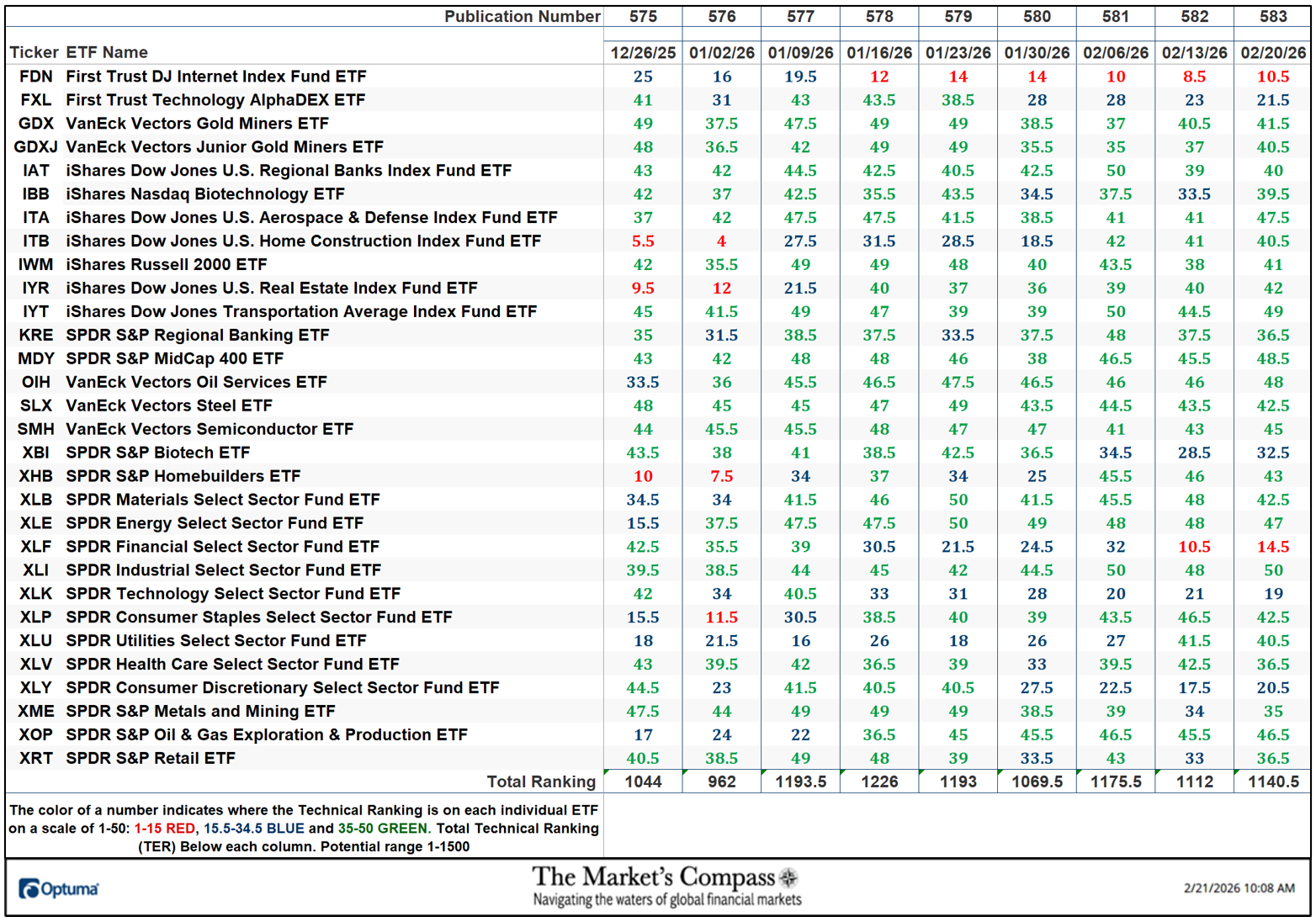
The Complete Technical Rating or “TER” of the U.S. Index and Sector ETFs rose +2.56% final week to 1140.5 from 1112 the earlier week which was a drop from the 1176.5 studying of 1226 three weeks in the past after waffling forwards and backwards for the reason that 1226 overbought studying for the week ending January sixteenth.
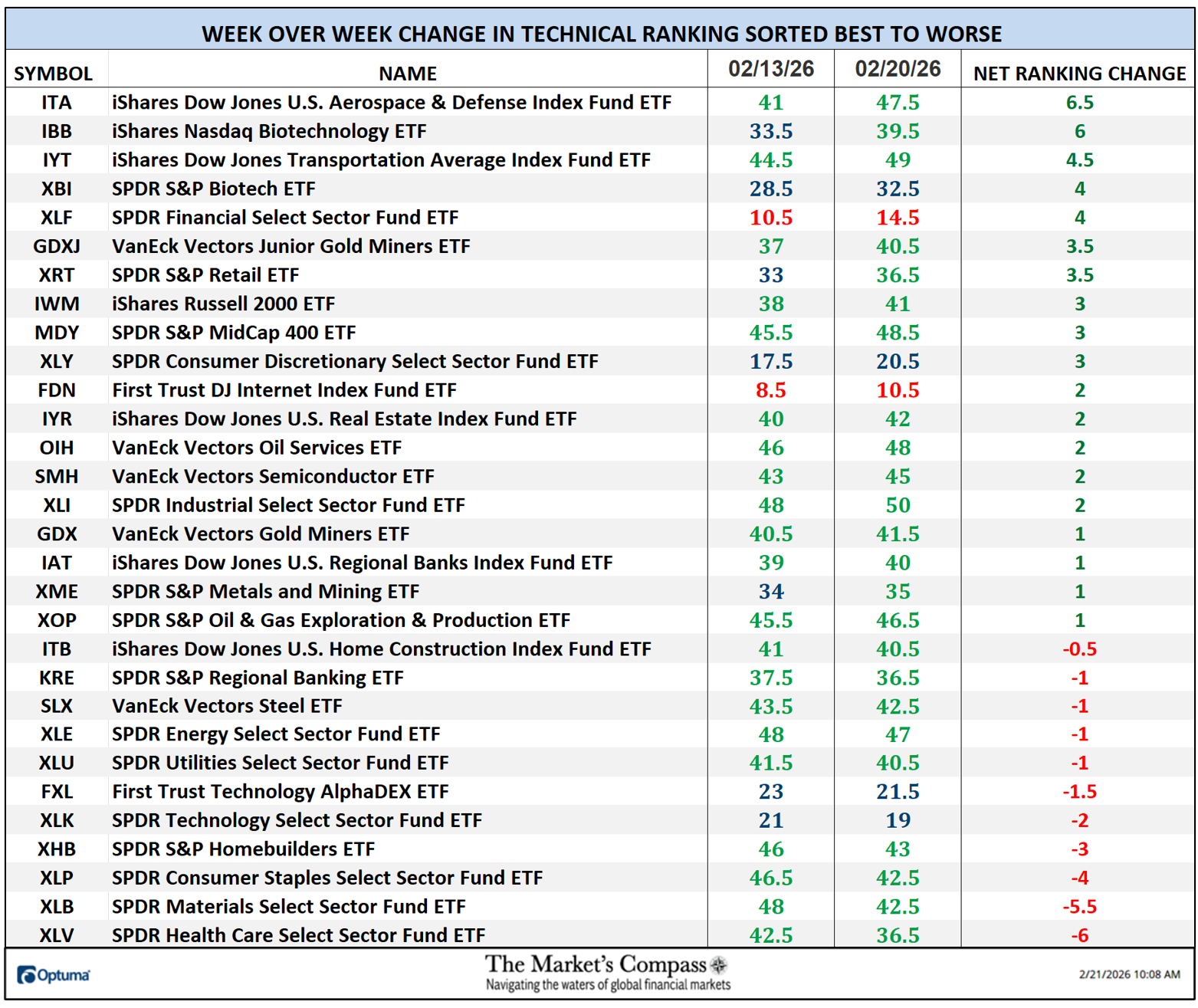
Nineteen ETFs registered will increase of their TRs final week, and eleven ETF TRs fell. The unfold between the most effective gainers in TR and drop in TR was the narrowest in latest reminiscence. Twenty-four ETF TRs ended the week within the “inexperienced zone” (TRs from 35 to 50), 4 ended the week within the “blue zone” (TRs from 15.5 to 34.5) and two remained within the “crimson zone” (TRs between 0 and 15), these was the SPDR Monetary Choose Sector Fund ETF (XLF) and the First Belief DJ Web Index Fund ETF (FDN). That was vs. the earlier week when there have been twenty-one within the “inexperienced zone”, seven had been within the “blue zone”, and two had been within the “crimson zone”. The common TR achieve on the week was +0.76 vs. the week earlier than common TR lack of -2.14. The week earlier than common was skewed by a 21.5 TR loss within the SPDR Monetary Choose Sector Fund ETF (XLF).
The Relative Rotation Graph, generally known as RRGs had been developed in 2004-2005 by Julius de Kempenaer. These charts are a novel visualization device for relative energy evaluation. Chartists can use RRGs to research the relative energy developments of a number of securities towards a typical benchmark, (on this case the SPX Index) and towards one another over any given time interval (within the case under, each day) over the previous three weeks. The ability of RRG is its capacity to plot relative efficiency on one graph and present true rotation. All RRGs charts use 4 quadrants to outline the 4 phases of a relative pattern. The Optuma RRG charts makes use of, From Main (in inexperienced) to Weakening (in yellow) to Lagging (in pink) to Bettering (in blue) and again to Main (in inexperienced). True rotations may be seen as securities transfer from one quadrant to the opposite over time. That is solely a short clarification of tips on how to interpret RRG charts. To study extra, see the submit scripts and hyperlinks on the finish of this Weblog.
Not all 30 US Index and Sector ETFs are plotted on this RRG Chart. I’ve finished this for readability functions. These which I imagine are of upper technical curiosity stay.
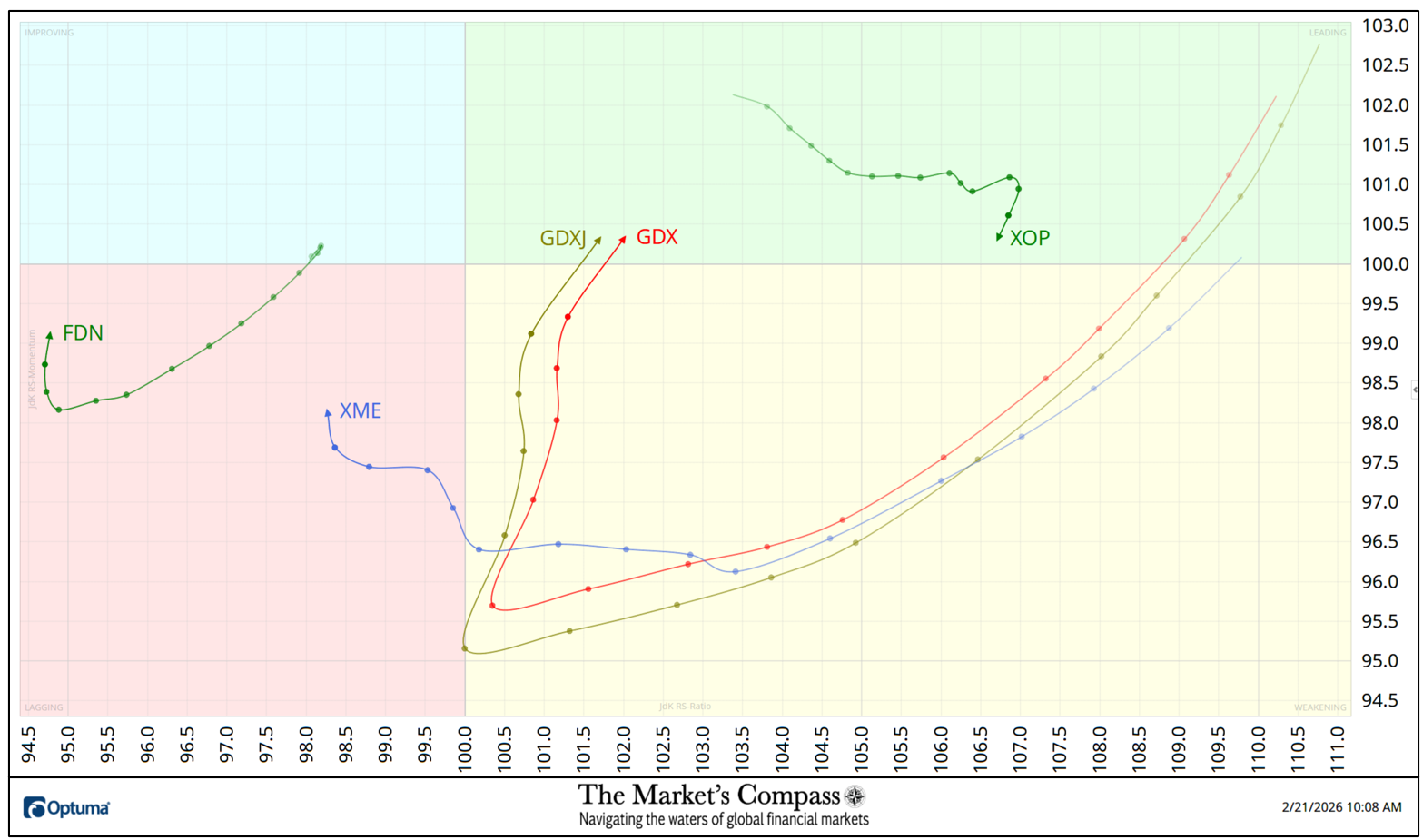
Not surprisingly, contemplating they’re all the time related at their hips, the VanEck Vectors Gold Miners ETF (GDX) and VanEck Vectors Junior Gold Miners ETF (GDXJ) each fell in tandem out of the Main Quadrant into the Weakening Quadrant two weeks in the past however turned sharply final week, regaining Relative Energy Momentum and reentered the Main Quadrant late final week. Though the SPDR S&P Metals and Miners ETF (XME) initially fell in tandem with the GDX and GDXJ it didn’t hook sharply increased and it solely managed to show up and enter the Lagging Quadrant. Though it has misplaced a level of Relative Energy Momentum the SPDR S&P Oil & Gasoline Exploration & Manufacturing ETF (XOP) stays within the Main Quadrant and continued to sport the second finest Relative Energy ratio vs. the S&P 500 Index on the finish of final week behind the VanEck Vectors Oil Providers ETF (OIH see the Tabulation Desk under). The First Belief DJ Web Index Fund ETF (FDN) hooked increased late final week regaining a small measure of Relative Energy Momentum, however it stays within the Lagging Quadrant marking the weakest Relative Energy Ratio of the 30 ETFs tracked within the Research.
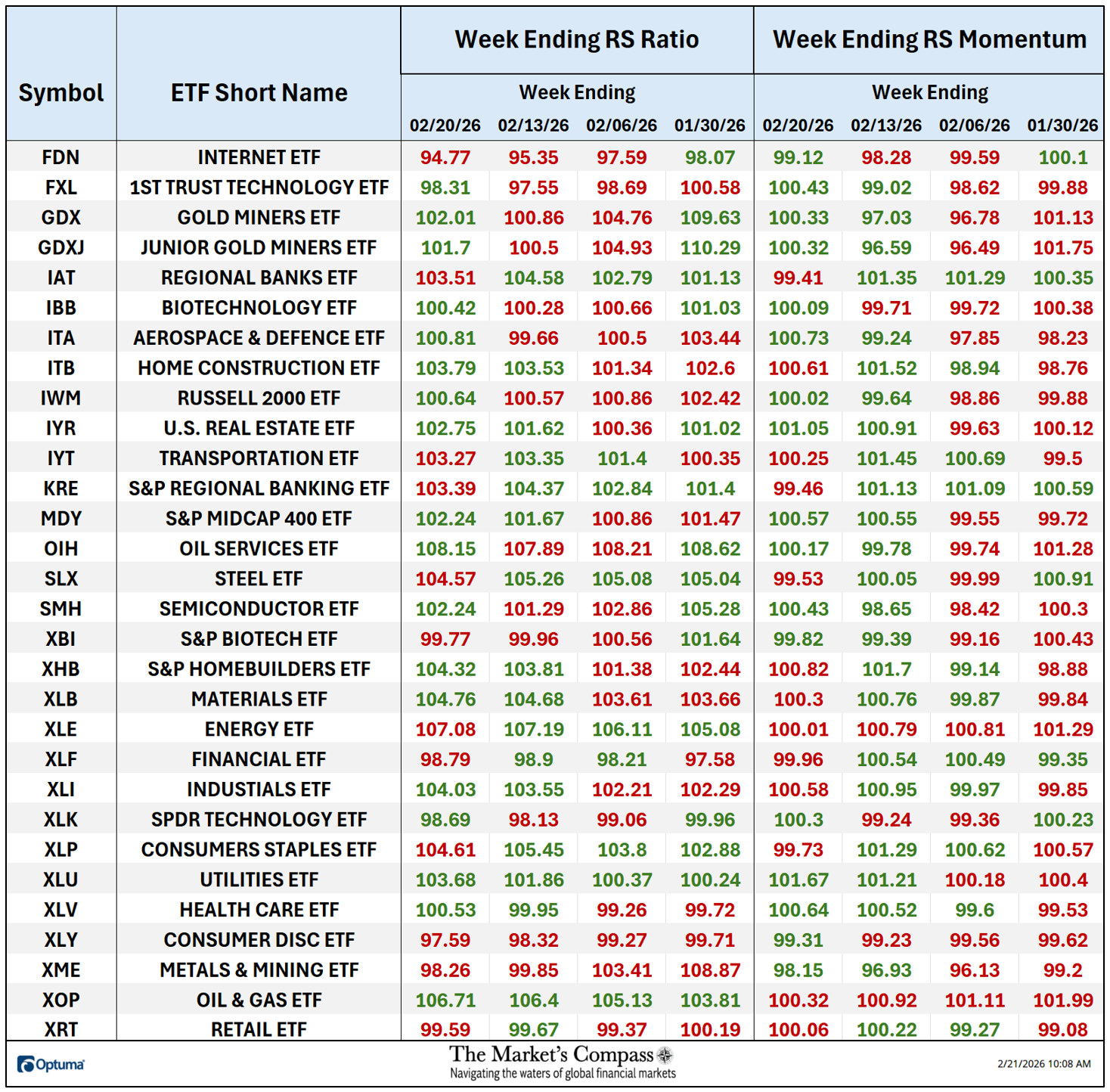
The Relative Energy and Relative Energy “Tabulation Desk” begins with the readings on the finish of final week adopted by the trailing three weeks that features the Readings from the final Research. If there was an enchancment in both the Relative Energy Ratio or the Relative Energy Momentum studying on a week-over-week foundation I’ve highlighted it in inexperienced. If there was a contraction in both, it’s highlighted in crimson and an unchanged studying in both will stay in black. The colour-coding system serves as a warmth map over the previous 4 Friday’s readings highlighting both the continued enchancment, deterioration, or stasis vs. the benchmark, the SPX Index.
*The Technical Situation Elements are derived from a calculation of the full Particular person US Index and Sector ETF Technical Rankings. What’s proven within the excel panel under is the full TCFs of all thirty TRs. Just a few TCFs carry extra weight than the others, such because the Weekly Pattern Issue and the Weekly Momentum Think about compiling every particular person TR of every of the 30 ETFs. Due to that, the excel sheet under calculates every issue’s weekly studying as a proportion of the attainable whole.
To totally perceive the development the of The Technical Situation Elements go to the MC’s Technical Indicators web page at www.themarketscompass.com and go to “us etfs”.
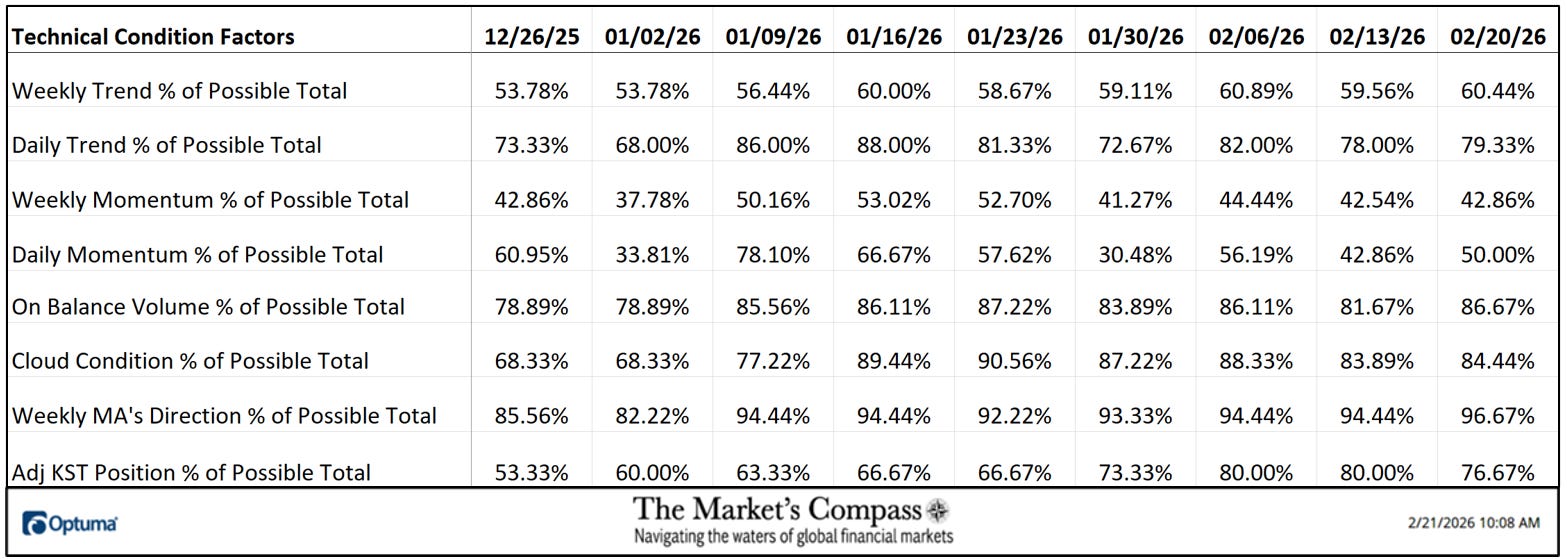
One technical takeaway can be, for instance, if the Day by day Momentum Situation Technical Issue or DMCTF rose to an excessive between 85% and 100%, it might counsel a short-term overbought situation. Conversely, a studying within the vary of 0% to fifteen% would counsel an oversold situation was growing. This previous week a impartial studying of fifty.00% was registered within the DMCTF or 105 out of a complete of 210 constructive factors, which was up from 42.86% the earlier week.
As a affirmation device, if all eight TCFs enhance on every week over week foundation, extra of the 30 ETFs are bettering internally on a technical foundation confirming a broader market transfer increased (consider an advance/decline calculation). Conversely if all eight TCFs fell over the week it confirms a transfer decrease within the broader market. Final week seven TCFs gained floor and one fell.
The Complete US ETF Technical Rating (“TER”) Indicator is a complete of all 30 ETF rankings and may be checked out as a affirmation/divergence indicator in addition to an overbought oversold indicator.
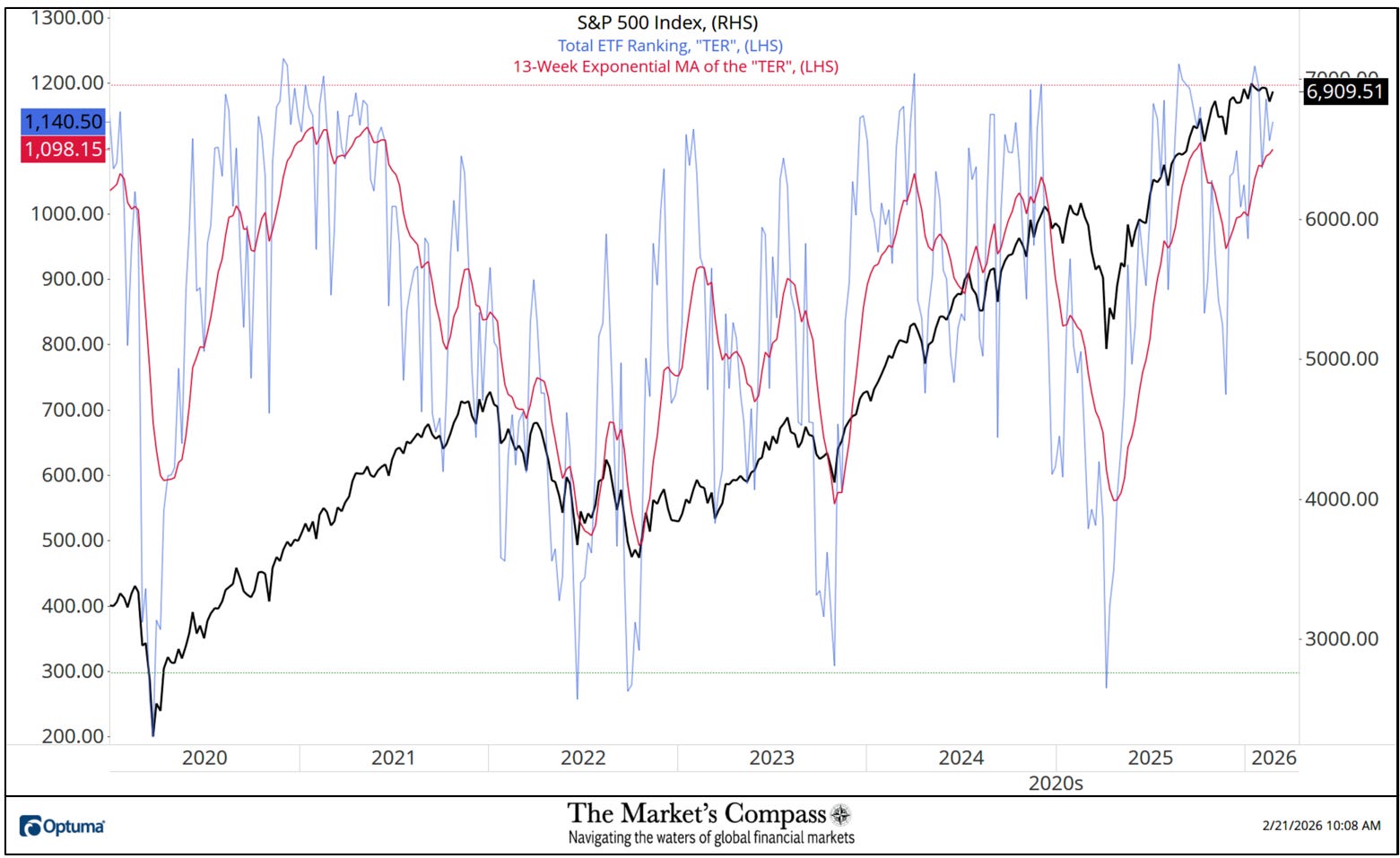
The SPX Index hit a wall on the 7000 degree and as will probably be seen additional into this week’s Research, every week in the past final Thursday, the big cap index pulled again sharply earlier than final week’s rebound. The Complete ETF Rating has been churning sideways slightly below overbought territory, however the 13-Week Exponential Transferring Common has managed to proceed to trace increased.
The Weekly Common Technical Rating (“ATR”) is the common Technical Rating of the 30 US Index and Sector ETFs we monitor. Just like the TER, it’s a affirmation/divergence in addition to an overbought/oversold indicator.
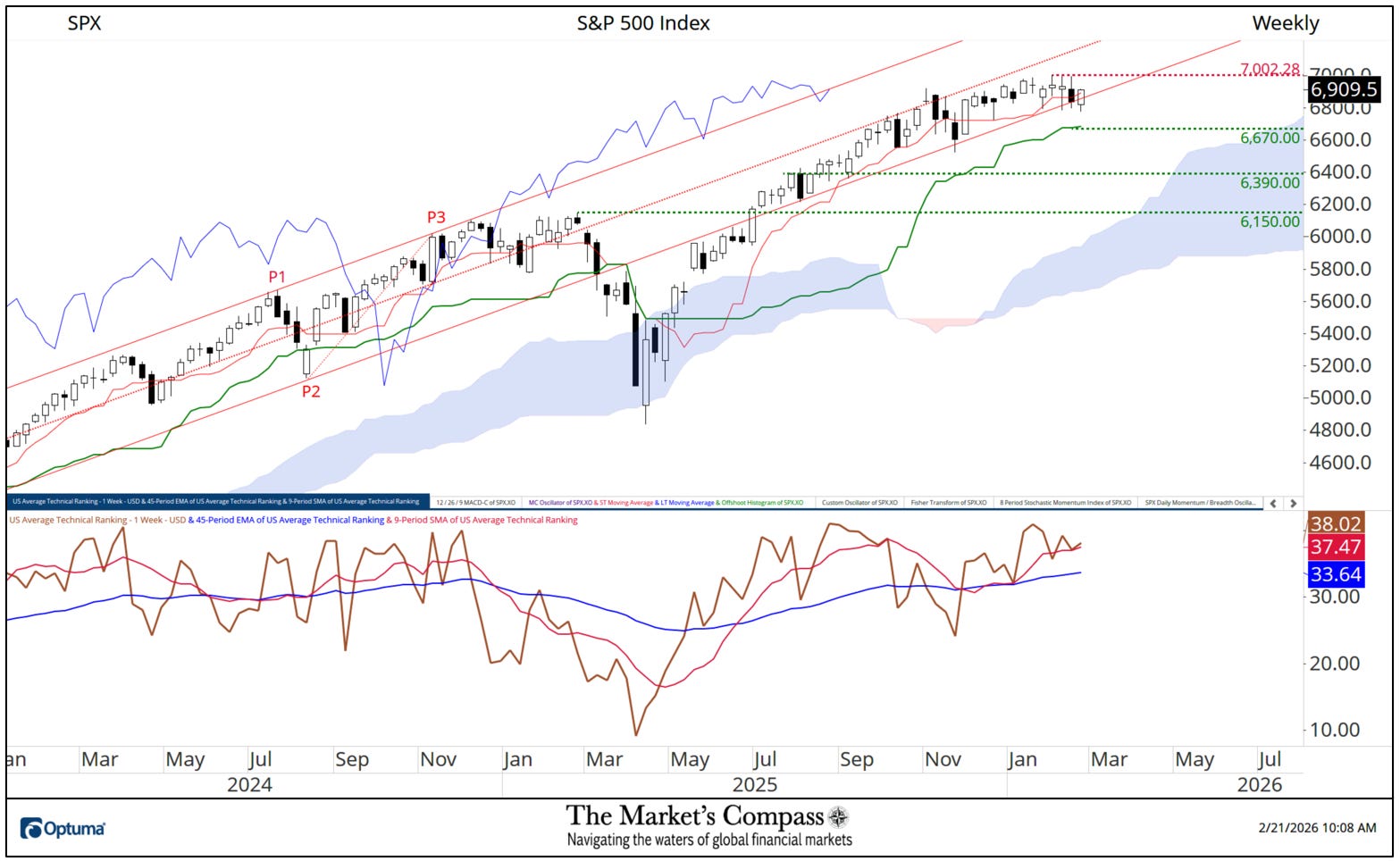
After rapping its head at simply above the 7,000 degree for 3 consecutive weeks, the S&P 500 Index fell under the Schiff Modified Pitchfork’s (crimson P1-P3) Decrease Parallel (stable crimson line) on an intra-week foundation final week however managed to get better at weeks finish closing again into the confines of the Pitchfork. The Common Technical Rating Oscillator has been churning sideways giving little directional clue as to cost route, however the worth sample is starting to look “toppy”. The feedback on the Day by day chart will tackle the shorter-term technical situation however first…
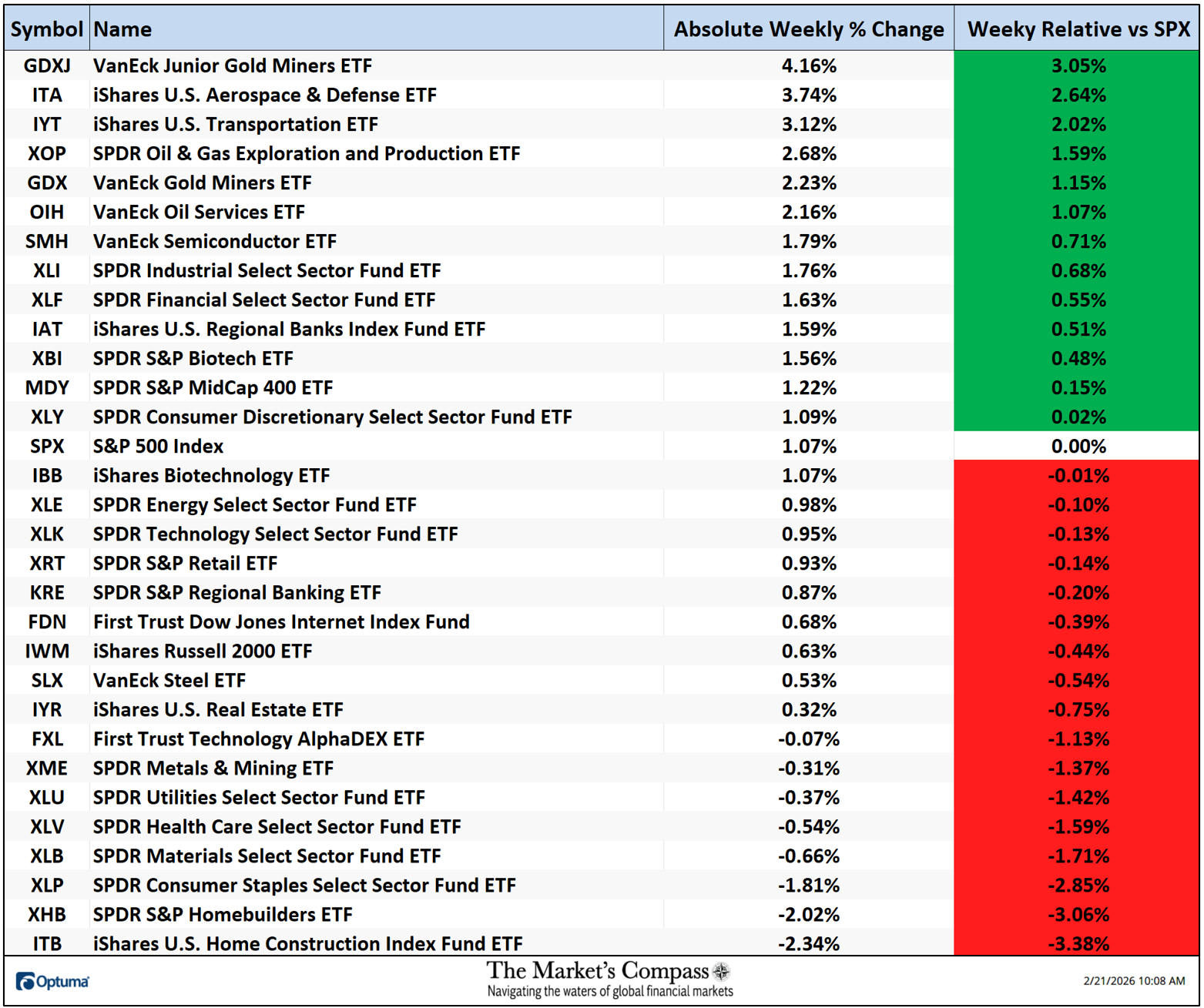
Twenty-two of the U.S. Index and Sector ETFs had been up on an absolute foundation final week and eight misplaced floor. 13 ETFs outpaced the +1.07% achieve within the SPX Index on a relative foundation and seventeen underperformed. The 5-Day Common Absolute achieve was +0.90% vs. the week earlier than Common Absolute achieve of +0.26%.
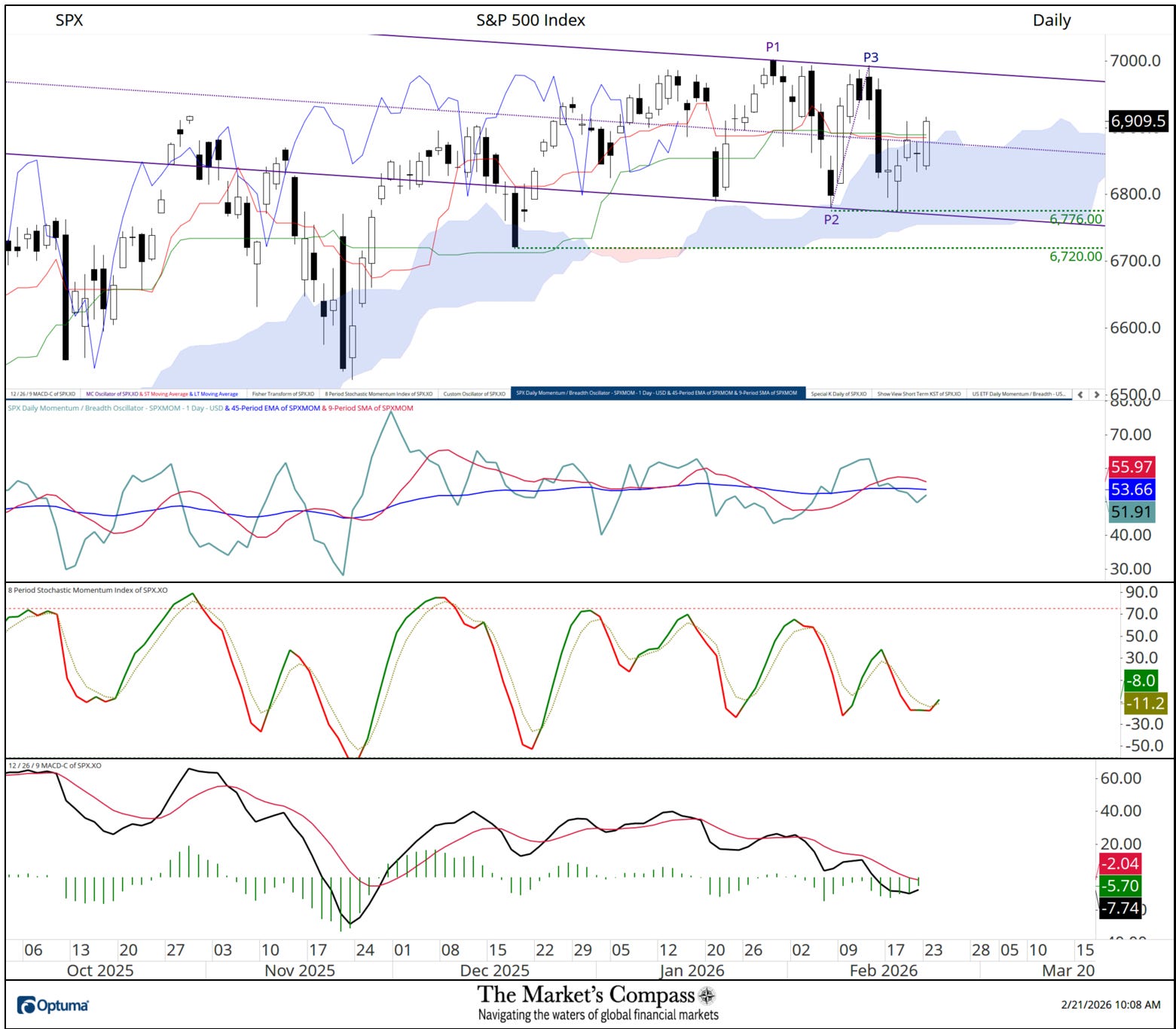
Every week in the past, final Thursday the SPX fell under Cloud help, the Kijun Plot, and the Median Line (violet dotted line) of the newly drawn Schiff Modified Pitchfork (violet P1-P3). The big-cap index discovered help on the P2 worth pivot low and the Decrease Parallel (stable violet line) final Tuesday and on the finish of final week the index retook the bottom above the Cloud mannequin. The unstable sideways chop continues as witnessed by the SPX each day Momentum / Breadth Oscillator. The 45-Day Exponential Transferring Common (blue line) of the Oscillator has been flat-lining for weeks with the shorter-term 9-Day Transferring Common crossing above and under it. Though the shorter-term Stochastic Momentum Index is popping and hooking increased with the worth restoration final week, the sequence of decrease highs stays in place and MACD stays beneath its sign line because it enters detrimental territory. The value motion doesn’t seem like consolidation to a transfer increased however extra like unstable rotation out and in of sectors which smells like distribution as to me. The very best-case situation is that the index could solely be caught in a snow drift.
*For readers who’re unfamiliar with the technical phrases or instruments referred to within the feedback on the technical situation of the SPX can avail themselves of a short tutorial titled, Instruments of Technical Evaluation and an in-depth complete lesson on Pitchforks is accessible on my web site…
Charts are courtesy of Optuma whose charting software program permits the Technical Rankings to be calculated and again examined.
To obtain a 30-day trial of Optuma charting software program go to…
