

“Among the hurdles have been tackling the problem of the necessity to transfer at tempo whereas we’ve a legacy enterprise,” says Tamas Szabo, the Group CEO of Pepperstone. These hurdles sat on the coronary heart of the retail dealer’s growth from conventional CFD into bodily crypto. This was as soon as a distinct segment transition, however has since began to edge into the mainstream.
Tamas Szabo, CEO at Pepperstone
As of as we speak, IG Group has entered the spot crypto enterprise, whereas Capital.com and XTB are getting ready to observe, and CMC Markets has signalled broader ambition that extends into decentralised finance. Pepperstone, in the meantime, has simply launched its bodily crypto enterprise for Australian shoppers. “So, we’ve constructed a big standalone crypto group,” Szabo goes on to clarify how the dealer moved to beat these constraints.
The Web’s Cash is Now Attracting Skilled Merchants
In line with CryptoQuant, a blockchain analytics and on-chain knowledge platform, buying and selling quantity on the spot cryptocurrency market reached US$18.6 trillion final 12 months, a 9% improve year-on-year. Crypto should still be risky, however it’s now not marginal. For a lot of the previous decade, one agency sat squarely on the centre of this exercise. At its peak in 2023, Binance, the world’s largest digital-asset change, dealt with near 60% of all spot crypto trades, the place precise possession of property modifications arms instantly somewhat than through derivatives – or on the “spot”.
Not too long ago, nevertheless, its grip has loosened.
CoinDesk knowledge present that by December 2025, Binance’s share of world spot buying and selling quantity had fallen to round 25%, its lowest degree since early 2021. The lacking quantity didn’t migrate in a single neat route. Some flowed to rival exchanges, some to decentralised platforms, and brokers are actually positioning themselves to seize a share of it.
2025 crypto change exercise in evaluation.
Spot quantity reached $18.6T (+9% YoY) whereas perpetuals surged to $61.7T (+29%), with Binance dominating spot, BTC perps, liquidity, and reserves.
Development is derivative-led, and market energy continues to pay attention on the high. pic.twitter.com/Om8udJJ9Qv
— CryptoQuant.com (@cryptoquant_com) January 12, 2026
“A Lengthy-Time period Conviction” for Brokers
One of many earliest mainstream brokers to take crypto severely was eToro, now one of many world’s largest multi-asset platforms. “From the outset, eToro approached spot crypto with a long-term conviction that crypto is right here to remain, including bitcoin to the platform as early as 2013 when demand was restricted, and market sentiment was extremely skeptical,” says Adi Lasker Gattegno, the fintech’s Director of Liquidity Administration and Crypto Operations.
Perspective issues. In 2013, Coinbase, as we speak the world’s second-largest crypto change, was a fledgling startup and reported promoting simply US$1 million price of bitcoin in a single month, at costs hovering above $22 per coin. That very same 12 months, the American novelist Charles Stross used bitcoin in his science-fiction Hugo Award-shortlisted novel Neptune’s Brood as a fictional interstellar foreign money, exactly as a result of it was obscure sufficient to sound believable in a far-future setting. Crypto was, fairly actually, science fiction.
Crypto’s rise owes a lot to regulation. In 2018, the European Securities and Markets Authority (ESMA) clamped down on CFDs, capping leverage and proscribing retail advertising and marketing. Some nationwide watchdogs went additional, steadily narrowing CFD enterprise. In January 2026, Israel-based dealer Plus500 turned the newest within the development, halting onboarding for Spanish CFD shoppers after the native regulator adopted one of many EU’s hardest interpretations of the foundations.
In the meantime, clearer crypto frameworks such because the EU’s MiCA and America’s GENIUS Act lent digital property a legitimacy CFDs more and more lack.
Adi Lasker Gattegno, Director of Liquidity Administration and Crypto Operations of eToro
In line with the 2025 World State of Crypto report by the crypto change Gemini Belief, primarily based on a survey of greater than 7,200 customers throughout the US, UK, France, Italy, Singapore and Australia, practically one in 4 respondents stated they owned crypto.
Provide, inevitably, has adopted demand. “Our providing has grown right into a holistic providing that caters to each crypto-native customers and conventional retail traders inside a regulated, multi-asset setting. We now help 150 crypto property, alongside companies corresponding to staking, crypto-focused Good Portfolios, and CopyTrader,” Gattegno says.
Towards the tip of 2025, Pepperstone’s Szabo, talking on the digital asset convention AusCryptoCon in Sydney, introduced that the CFD dealer can be making the leap to identify crypto in 2026, and as we speak it launched the devoted crypto change. “Inside and exterior analysis has proven that CFD merchants are heavy crypto traders,” he explains a part of the reasoning to FinanceMagnates.com.
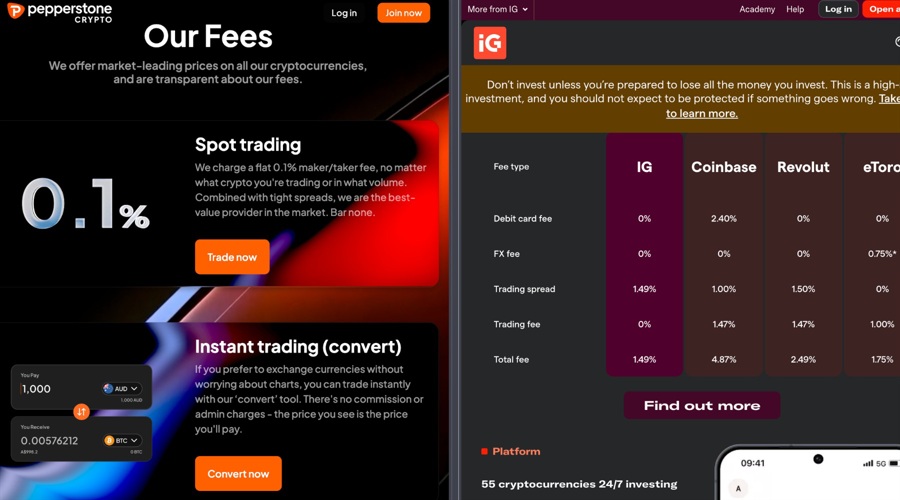
Having simply launched its product, the dealer plans a measured entry. The preliminary focus might be on adoption and consumer expertise, constructed round a flat 0.1% price, tight spreads and deep liquidity. “Over time, as we increase the product providing and the market grows, spot crypto is anticipated to enrich our conventional merchandise and develop into a significant a part of our total enterprise,” Szabo provides.
Plug-and-Play Vs In-Home Tech
When contemplating crypto growth, brokers should first tackle one query: whether or not to construct the infrastructure in-house or go along with white-label options. Each have their benefits and drawbacks.
White-label tech infrastructure has at all times been a part of the brokerage business, and the identical is true for crypto exchanges as properly. These days, a rising ecosystem of know-how suppliers presents plug-and-play infrastructure designed to sit down comfortably alongside present CFD choices.
Shift Markets is one such supplier. Since 2019, it has developed a white-label crypto answer aimed primarily at FX and CFD brokers trying to enter digital property with out reinventing the wheel. “Our focus is much less on introducing a brand new product in isolation, and extra on enabling crypto to perform as a pure extension of a dealer’s present multi-asset providing,” says Ian McAfee, the agency’s co-founder and CEO.
Out of the field, Shift’s platform supplies aggregated liquidity, real-time order matching, pockets infrastructure, crypto and stablecoin funding and a full again workplace.
Ian McAfee, co-founder and CEO of Shift Markets
One other is B2BROKER, a world fintech whose core clientele consists of banks, crypto companies and, above all, CFD brokers. “We developed a full stack of merchandise to help crypto companies,” says Arthur Azizov, the corporate’s founder and CEO. This consists of its personal brokerage platform, B2TRADER; spot and perpetual futures liquidity, that are coming shortly; the B2CORE back-office and CRM system; and B2BINPAY, its crypto funds and wallet-management platform.
Not everybody, nevertheless, opts for a third-party route.“Our spot crypto infrastructure is fully in-house,” says Tamas Szabo, “leveraging 15 years of expertise in CFD buying and selling. It supplies full oversight of execution high quality, deep liquidity and pricing and system safety.”
It’s price mentioning that originally, IG additionally sought third-party infrastructure, partnering with digital buying and selling platform Uphold. Later, although, the dealer acquired Australian crypto change Unbiased Reserve, aiming to roll out crypto merchandise for the Center East and APAC area.
Deployment With out Reinvention
Deployment might be a lot smoother than what the complexity would possibly recommend. In line with each third-party tech suppliers, most brokers favour software-as-a-service (SaaS) fashions, which supply the quickest path to market. A minority go for hybrid cloud deployments utilizing their very own groups, whereas totally on-premise environments are uncommon.
“Some brokers want having extra management, and a few in sure jurisdictions encounter regulatory necessities for controlling extra of the setting,” McAfee notes.
The onboarding timelines might be brisk, owing a lot to automation. Azizov says that preliminary setup can take as little as three hours, adopted by round 9 days of configuration, branding and safety work. From contract signing to go-live, the complete course of might be accomplished in underneath ten days.
In apply, integration with present brokerage programs will not be disruptive, with API-led approaches designed to suit round established know-how stacks somewhat than change them outright.
The limiting issue is never the know-how itself, however a dealer’s personal technical readiness and urge for food for change.
For Pepperstone, spot crypto is built-in into the dealer’s wider platform ecosystem, whereas remaining operationally and regulatorily distinct by separate internet and cell platforms. Deposits, withdrawals, and reconciliations are processed by the identical safe programs.
Deep Liquidity is Obligatory, However Can Be a Problem
“The important thing focus areas have been making certain deep liquidity, sustaining platform stability underneath peak buying and selling, and supporting safe deposit and withdrawal processes,” says Szabo, reflecting on the challenges Pepperstone has confronted in transferring from CFDs to identify crypto. Certainly, crypto liquidity will not be a straightforward equation to unravel, as it’s scattered throughout chains, exchanges and OTC desks, complicating the duty of worth formation. For Peppestone, it was addressed by leaning on the dimensions of its derivatives enterprise. “We course of over US$6 billion in crypto CFD quantity every month, so we’re capable of help sturdy liquidity and dependable execution for our shoppers,” he explains.
For these counting on plug-and-play options, know-how suppliers tackle liquidity by aggregating costs from main venues and delivering them to brokers’ platforms, both as exterior worth feeds or embedded straight inside a dealer’s personal crypto change.
Past these aggregation layers, there are additionally matching engines constructed particularly for crypto markets. One such supplier is Finery Markets, a crypto-focused digital communication community (ECN) which has additionally partnered with B2BROKER. In line with its founder and CEO, Konstantin Shulga, the agency presents two major integration paths: entry to aggregated institutional liquidity through its personal ECN, or a Crypto-as-a-Service turnkey answer.
Entry to the Finery’s institutional liquidity community is offered by a single integration level, combining execution with core back-office capabilities corresponding to real-time reporting, place administration and threat controls inside one technical framework.
“The selection will depend on the dealer’s goals,” he says. The ECN mannequin fits companies in search of finest execution and internalisation, whereas the turnkey choice is designed for these wanting a fast, zero-development launch.
Konstantin Shulga, CEO and co-founder of Finery Markets
“Execution and custodial dangers stay strictly decoupled,” Shulga stresses. Brokers are free to work with any certified custodian, with native integrations obtainable for suppliers corresponding to BitGo and Fireblocks. To unravel latency points – in crypto markets, milliseconds matter, notably throughout bouts of volatility – Amazon Internet Companies appears to be the popular choice, as each B2BROKER and Finery Markets leverage the US large’s community. “For optimum efficiency,” Azizov notes, “we often advocate monetary hubs like London to attenuate latency between the platform and our liquidity suppliers.”
Compliance, although, is dealt with at arm’s size. Finery doesn’t maintain consumer property, and buying and selling is non-custodial. As a result of trades are bilateral, the authorized contract sits straight between counterparties, permitting brokers to plug in their very own KYC, transaction-monitoring instruments and controls according to native regulation.
“Brokers Ought to By no means Outsource Their Model, Consumer Relationship or Business Resolution-Making”
Spot crypto includes actual property, actual wallets and actual settlement. When programs are constructed in-house, duty is obvious; when capabilities are outsourced, readability over who owns what turns into essential.
On Shift’s platform, brokers retain operational management over treasury administration, liquidity optimisation and day-to-day monitoring. In-house groups are required for reconciliation and efficiency checks. The platform itself manages orders and tracks property on a digital ledger, whereas connecting brokers to specialist suppliers for custody, liquidity, funds, KYC and AML.
B2BROKER presents a extra closed-loop ecosystem during which each technical and operational parts are tightly built-in. Core buying and selling logic, pre-integrated KYC, funds and back-office programs are bundled collectively, supported by devoted account managers
Arthur Azizov, founder and CEO of B2BROKER
Azizov, although, is categorical that sure issues ought to by no means be outsourced. “Brokers ought to by no means outsource their model, consumer relationship or business decision-making,” Azizov notes. “That possession should at all times stick with the dealer.”
“You Are No Longer Managing Contracts, You Are Managing Actual Belongings.”
For all of the progress in tooling, transferring from CFDs to identify crypto stays a conceptual leap. “Transitioning to identify buying and selling means a elementary change in enterprise logic and the brokerage’s working mannequin,” says Azizov. Treasury administration is the clearest instance: CFD buying and selling abstracts all the things right into a base foreign money and spot crypto doesn’t. Shoppers can maintain, switch and withdraw actual property – bitcoin, ether, stablecoins – forcing brokers to handle multi-asset balances, on-chain flows and real-time liquidity. “You’re now not managing contracts,” B2BROKER CEO stresses. “You’re managing actual property.”
McAfee agrees. Providing spot buying and selling requires integration with custodians and the upkeep of balances throughout all supported cryptos. “This provides further complexity,” he goes on, “because the dealer must rebalance their treasury to align with consumer holdings, in addition to keep balances at liquidity suppliers – or guarantee they’ll course of end-of-day settlements in a number of currencies.”
There’s additionally a bent to conflate spot buying and selling with perpetual futures, which really feel extra acquainted to CFD brokers as a result of they depend on comparable leverage, margins and funding charges. With spot buying and selling, although, Azivov notes, shoppers can solely commerce what they really maintain, which modifications behaviour, publicity and threat administration.
Regulation provides one other layer of complexity, as crypto licensing regimes typically differ sharply from these governing CFDs. “Discovering the proper regulatory perimeter – and understanding what merchandise might be supplied in every market – is among the most difficult features of such a transition,” McAfee stresses.
Refined brokers, he provides, are likely to ask laborious questions early: which property are supported, how balances are managed, how reconciliations work, and the way threat controls function. Solely then do they flip to the regulatory maze.
“A standard mistake we see is a dealer not at all times totally assessing the standard or viability of a vendor that they selected to combine to the platform,” McAfee notes. One other is counting on single factors of failure, corresponding to one liquidity supplier, one cost rail, even one key particular person. Contingency planning, Azizov says, is usually an afterthought.
Many brokers additionally prioritise velocity to market over the unglamorous work of constructing audit trails, permission buildings and monitoring programs. These particulars, nevertheless, are exactly what regulators scrutinise as soon as a enterprise scales.
A Convergence Afoot?
As extra brokers add spot crypto, it factors to a deeper shift that goes past know-how stacks or liquidity plumbing: Does being a pure-play retail CFD dealer nonetheless maintain?
On the identical time, crypto exchanges have been edging into conventional dealer territory, typically by acquisition somewhat than invention. Crypto.com, Coinbase and Kraken are amongst people who, lately, have purchased established EU companies holding MiFID licences – ready-made passports into regulated markets.
The actual query, then, will not be merely whether or not being a pure-play CFD dealer stays a sustainable mannequin, however whether or not crypto and conventional derivatives are actually approaching a degree of convergence – technologically, commercially and, more and more, within the eyes of shoppers themselves.
“Whereas the boundaries between brokers and exchanges are evolving,” says Szabo, consumer priorities stay targeted on price, execution high quality, belief and importantly nice UX and ease of use. Our Australian-made, low-cost, high-liquidity mannequin supplies readability and reliability, which we consider will proceed to distinguish Pepperstone available in the market.”
“Among the hurdles have been tackling the problem of the necessity to transfer at tempo whereas we’ve a legacy enterprise,” says Tamas Szabo, the Group CEO of Pepperstone. These hurdles sat on the coronary heart of the retail dealer’s growth from conventional CFD into bodily crypto. This was as soon as a distinct segment transition, however has since began to edge into the mainstream.
Tamas Szabo, CEO at Pepperstone
As of as we speak, IG Group has entered the spot crypto enterprise, whereas Capital.com and XTB are getting ready to observe, and CMC Markets has signalled broader ambition that extends into decentralised finance. Pepperstone, in the meantime, has simply launched its bodily crypto enterprise for Australian shoppers. “So, we’ve constructed a big standalone crypto group,” Szabo goes on to clarify how the dealer moved to beat these constraints.
The Web’s Cash is Now Attracting Skilled Merchants
In line with CryptoQuant, a blockchain analytics and on-chain knowledge platform, buying and selling quantity on the spot cryptocurrency market reached US$18.6 trillion final 12 months, a 9% improve year-on-year. Crypto should still be risky, however it’s now not marginal. For a lot of the previous decade, one agency sat squarely on the centre of this exercise. At its peak in 2023, Binance, the world’s largest digital-asset change, dealt with near 60% of all spot crypto trades, the place precise possession of property modifications arms instantly somewhat than through derivatives – or on the “spot”.
Not too long ago, nevertheless, its grip has loosened.
CoinDesk knowledge present that by December 2025, Binance’s share of world spot buying and selling quantity had fallen to round 25%, its lowest degree since early 2021. The lacking quantity didn’t migrate in a single neat route. Some flowed to rival exchanges, some to decentralised platforms, and brokers are actually positioning themselves to seize a share of it.
2025 crypto change exercise in evaluation.
Spot quantity reached $18.6T (+9% YoY) whereas perpetuals surged to $61.7T (+29%), with Binance dominating spot, BTC perps, liquidity, and reserves.
Development is derivative-led, and market energy continues to pay attention on the high. pic.twitter.com/Om8udJJ9Qv
— CryptoQuant.com (@cryptoquant_com) January 12, 2026
“A Lengthy-Time period Conviction” for Brokers
One of many earliest mainstream brokers to take crypto severely was eToro, now one of many world’s largest multi-asset platforms. “From the outset, eToro approached spot crypto with a long-term conviction that crypto is right here to remain, including bitcoin to the platform as early as 2013 when demand was restricted, and market sentiment was extremely skeptical,” says Adi Lasker Gattegno, the fintech’s Director of Liquidity Administration and Crypto Operations.
Perspective issues. In 2013, Coinbase, as we speak the world’s second-largest crypto change, was a fledgling startup and reported promoting simply US$1 million price of bitcoin in a single month, at costs hovering above $22 per coin. That very same 12 months, the American novelist Charles Stross used bitcoin in his science-fiction Hugo Award-shortlisted novel Neptune’s Brood as a fictional interstellar foreign money, exactly as a result of it was obscure sufficient to sound believable in a far-future setting. Crypto was, fairly actually, science fiction.
Crypto’s rise owes a lot to regulation. In 2018, the European Securities and Markets Authority (ESMA) clamped down on CFDs, capping leverage and proscribing retail advertising and marketing. Some nationwide watchdogs went additional, steadily narrowing CFD enterprise. In January 2026, Israel-based dealer Plus500 turned the newest within the development, halting onboarding for Spanish CFD shoppers after the native regulator adopted one of many EU’s hardest interpretations of the foundations.
In the meantime, clearer crypto frameworks such because the EU’s MiCA and America’s GENIUS Act lent digital property a legitimacy CFDs more and more lack.
Adi Lasker Gattegno, Director of Liquidity Administration and Crypto Operations of eToro
In line with the 2025 World State of Crypto report by the crypto change Gemini Belief, primarily based on a survey of greater than 7,200 customers throughout the US, UK, France, Italy, Singapore and Australia, practically one in 4 respondents stated they owned crypto.
Provide, inevitably, has adopted demand. “Our providing has grown right into a holistic providing that caters to each crypto-native customers and conventional retail traders inside a regulated, multi-asset setting. We now help 150 crypto property, alongside companies corresponding to staking, crypto-focused Good Portfolios, and CopyTrader,” Gattegno says.
Towards the tip of 2025, Pepperstone’s Szabo, talking on the digital asset convention AusCryptoCon in Sydney, introduced that the CFD dealer can be making the leap to identify crypto in 2026, and as we speak it launched the devoted crypto change. “Inside and exterior analysis has proven that CFD merchants are heavy crypto traders,” he explains a part of the reasoning to FinanceMagnates.com.
Having simply launched its product, the dealer plans a measured entry. The preliminary focus might be on adoption and consumer expertise, constructed round a flat 0.1% price, tight spreads and deep liquidity. “Over time, as we increase the product providing and the market grows, spot crypto is anticipated to enrich our conventional merchandise and develop into a significant a part of our total enterprise,” Szabo provides.
Plug-and-Play Vs In-Home Tech
When contemplating crypto growth, brokers should first tackle one query: whether or not to construct the infrastructure in-house or go along with white-label options. Each have their benefits and drawbacks.
White-label tech infrastructure has at all times been a part of the brokerage business, and the identical is true for crypto exchanges as properly. These days, a rising ecosystem of know-how suppliers presents plug-and-play infrastructure designed to sit down comfortably alongside present CFD choices.
Shift Markets is one such supplier. Since 2019, it has developed a white-label crypto answer aimed primarily at FX and CFD brokers trying to enter digital property with out reinventing the wheel. “Our focus is much less on introducing a brand new product in isolation, and extra on enabling crypto to perform as a pure extension of a dealer’s present multi-asset providing,” says Ian McAfee, the agency’s co-founder and CEO.
Out of the field, Shift’s platform supplies aggregated liquidity, real-time order matching, pockets infrastructure, crypto and stablecoin funding and a full again workplace.
Ian McAfee, co-founder and CEO of Shift Markets
One other is B2BROKER, a world fintech whose core clientele consists of banks, crypto companies and, above all, CFD brokers. “We developed a full stack of merchandise to help crypto companies,” says Arthur Azizov, the corporate’s founder and CEO. This consists of its personal brokerage platform, B2TRADER; spot and perpetual futures liquidity, that are coming shortly; the B2CORE back-office and CRM system; and B2BINPAY, its crypto funds and wallet-management platform.
Not everybody, nevertheless, opts for a third-party route.“Our spot crypto infrastructure is fully in-house,” says Tamas Szabo, “leveraging 15 years of expertise in CFD buying and selling. It supplies full oversight of execution high quality, deep liquidity and pricing and system safety.”
It’s price mentioning that originally, IG additionally sought third-party infrastructure, partnering with digital buying and selling platform Uphold. Later, although, the dealer acquired Australian crypto change Unbiased Reserve, aiming to roll out crypto merchandise for the Center East and APAC area.
Deployment With out Reinvention
Deployment might be a lot smoother than what the complexity would possibly recommend. In line with each third-party tech suppliers, most brokers favour software-as-a-service (SaaS) fashions, which supply the quickest path to market. A minority go for hybrid cloud deployments utilizing their very own groups, whereas totally on-premise environments are uncommon.
“Some brokers want having extra management, and a few in sure jurisdictions encounter regulatory necessities for controlling extra of the setting,” McAfee notes.
The onboarding timelines might be brisk, owing a lot to automation. Azizov says that preliminary setup can take as little as three hours, adopted by round 9 days of configuration, branding and safety work. From contract signing to go-live, the complete course of might be accomplished in underneath ten days.
In apply, integration with present brokerage programs will not be disruptive, with API-led approaches designed to suit round established know-how stacks somewhat than change them outright.
The limiting issue is never the know-how itself, however a dealer’s personal technical readiness and urge for food for change.
For Pepperstone, spot crypto is built-in into the dealer’s wider platform ecosystem, whereas remaining operationally and regulatorily distinct by separate internet and cell platforms. Deposits, withdrawals, and reconciliations are processed by the identical safe programs.
Deep Liquidity is Obligatory, However Can Be a Problem
“The important thing focus areas have been making certain deep liquidity, sustaining platform stability underneath peak buying and selling, and supporting safe deposit and withdrawal processes,” says Szabo, reflecting on the challenges Pepperstone has confronted in transferring from CFDs to identify crypto. Certainly, crypto liquidity will not be a straightforward equation to unravel, as it’s scattered throughout chains, exchanges and OTC desks, complicating the duty of worth formation. For Peppestone, it was addressed by leaning on the dimensions of its derivatives enterprise. “We course of over US$6 billion in crypto CFD quantity every month, so we’re capable of help sturdy liquidity and dependable execution for our shoppers,” he explains.
For these counting on plug-and-play options, know-how suppliers tackle liquidity by aggregating costs from main venues and delivering them to brokers’ platforms, both as exterior worth feeds or embedded straight inside a dealer’s personal crypto change.
Past these aggregation layers, there are additionally matching engines constructed particularly for crypto markets. One such supplier is Finery Markets, a crypto-focused digital communication community (ECN) which has additionally partnered with B2BROKER. In line with its founder and CEO, Konstantin Shulga, the agency presents two major integration paths: entry to aggregated institutional liquidity through its personal ECN, or a Crypto-as-a-Service turnkey answer.
Entry to the Finery’s institutional liquidity community is offered by a single integration level, combining execution with core back-office capabilities corresponding to real-time reporting, place administration and threat controls inside one technical framework.
“The selection will depend on the dealer’s goals,” he says. The ECN mannequin fits companies in search of finest execution and internalisation, whereas the turnkey choice is designed for these wanting a fast, zero-development launch.
Konstantin Shulga, CEO and co-founder of Finery Markets
“Execution and custodial dangers stay strictly decoupled,” Shulga stresses. Brokers are free to work with any certified custodian, with native integrations obtainable for suppliers corresponding to BitGo and Fireblocks. To unravel latency points – in crypto markets, milliseconds matter, notably throughout bouts of volatility – Amazon Internet Companies appears to be the popular choice, as each B2BROKER and Finery Markets leverage the US large’s community. “For optimum efficiency,” Azizov notes, “we often advocate monetary hubs like London to attenuate latency between the platform and our liquidity suppliers.”
Compliance, although, is dealt with at arm’s size. Finery doesn’t maintain consumer property, and buying and selling is non-custodial. As a result of trades are bilateral, the authorized contract sits straight between counterparties, permitting brokers to plug in their very own KYC, transaction-monitoring instruments and controls according to native regulation.
“Brokers Ought to By no means Outsource Their Model, Consumer Relationship or Business Resolution-Making”
Spot crypto includes actual property, actual wallets and actual settlement. When programs are constructed in-house, duty is obvious; when capabilities are outsourced, readability over who owns what turns into essential.
On Shift’s platform, brokers retain operational management over treasury administration, liquidity optimisation and day-to-day monitoring. In-house groups are required for reconciliation and efficiency checks. The platform itself manages orders and tracks property on a digital ledger, whereas connecting brokers to specialist suppliers for custody, liquidity, funds, KYC and AML.
B2BROKER presents a extra closed-loop ecosystem during which each technical and operational parts are tightly built-in. Core buying and selling logic, pre-integrated KYC, funds and back-office programs are bundled collectively, supported by devoted account managers
Arthur Azizov, founder and CEO of B2BROKER
Azizov, although, is categorical that sure issues ought to by no means be outsourced. “Brokers ought to by no means outsource their model, consumer relationship or business decision-making,” Azizov notes. “That possession should at all times stick with the dealer.”
“You Are No Longer Managing Contracts, You Are Managing Actual Belongings.”
For all of the progress in tooling, transferring from CFDs to identify crypto stays a conceptual leap. “Transitioning to identify buying and selling means a elementary change in enterprise logic and the brokerage’s working mannequin,” says Azizov. Treasury administration is the clearest instance: CFD buying and selling abstracts all the things right into a base foreign money and spot crypto doesn’t. Shoppers can maintain, switch and withdraw actual property – bitcoin, ether, stablecoins – forcing brokers to handle multi-asset balances, on-chain flows and real-time liquidity. “You’re now not managing contracts,” B2BROKER CEO stresses. “You’re managing actual property.”
McAfee agrees. Providing spot buying and selling requires integration with custodians and the upkeep of balances throughout all supported cryptos. “This provides further complexity,” he goes on, “because the dealer must rebalance their treasury to align with consumer holdings, in addition to keep balances at liquidity suppliers – or guarantee they’ll course of end-of-day settlements in a number of currencies.”
There’s additionally a bent to conflate spot buying and selling with perpetual futures, which really feel extra acquainted to CFD brokers as a result of they depend on comparable leverage, margins and funding charges. With spot buying and selling, although, Azivov notes, shoppers can solely commerce what they really maintain, which modifications behaviour, publicity and threat administration.
Regulation provides one other layer of complexity, as crypto licensing regimes typically differ sharply from these governing CFDs. “Discovering the proper regulatory perimeter – and understanding what merchandise might be supplied in every market – is among the most difficult features of such a transition,” McAfee stresses.
Refined brokers, he provides, are likely to ask laborious questions early: which property are supported, how balances are managed, how reconciliations work, and the way threat controls function. Solely then do they flip to the regulatory maze.
“A standard mistake we see is a dealer not at all times totally assessing the standard or viability of a vendor that they selected to combine to the platform,” McAfee notes. One other is counting on single factors of failure, corresponding to one liquidity supplier, one cost rail, even one key particular person. Contingency planning, Azizov says, is usually an afterthought.
Many brokers additionally prioritise velocity to market over the unglamorous work of constructing audit trails, permission buildings and monitoring programs. These particulars, nevertheless, are exactly what regulators scrutinise as soon as a enterprise scales.
A Convergence Afoot?
As extra brokers add spot crypto, it factors to a deeper shift that goes past know-how stacks or liquidity plumbing: Does being a pure-play retail CFD dealer nonetheless maintain?
On the identical time, crypto exchanges have been edging into conventional dealer territory, typically by acquisition somewhat than invention. Crypto.com, Coinbase and Kraken are amongst people who, lately, have purchased established EU companies holding MiFID licences – ready-made passports into regulated markets.
The actual query, then, will not be merely whether or not being a pure-play CFD dealer stays a sustainable mannequin, however whether or not crypto and conventional derivatives are actually approaching a degree of convergence – technologically, commercially and, more and more, within the eyes of shoppers themselves.
“Whereas the boundaries between brokers and exchanges are evolving,” says Szabo, consumer priorities stay targeted on price, execution high quality, belief and importantly nice UX and ease of use. Our Australian-made, low-cost, high-liquidity mannequin supplies readability and reliability, which we consider will proceed to distinguish Pepperstone available in the market.”
