

“95% of all merchants fail” is essentially the most generally used buying and selling associated statistic across the web. However no analysis paper exists that proves this quantity proper. Analysis even means that the precise determine is far, a lot larger. Within the following article we’ll present you 24 very shocking statistics financial scientists found by analyzing precise dealer knowledge and the efficiency of merchants. Some clarify very effectively why most merchants lose cash.

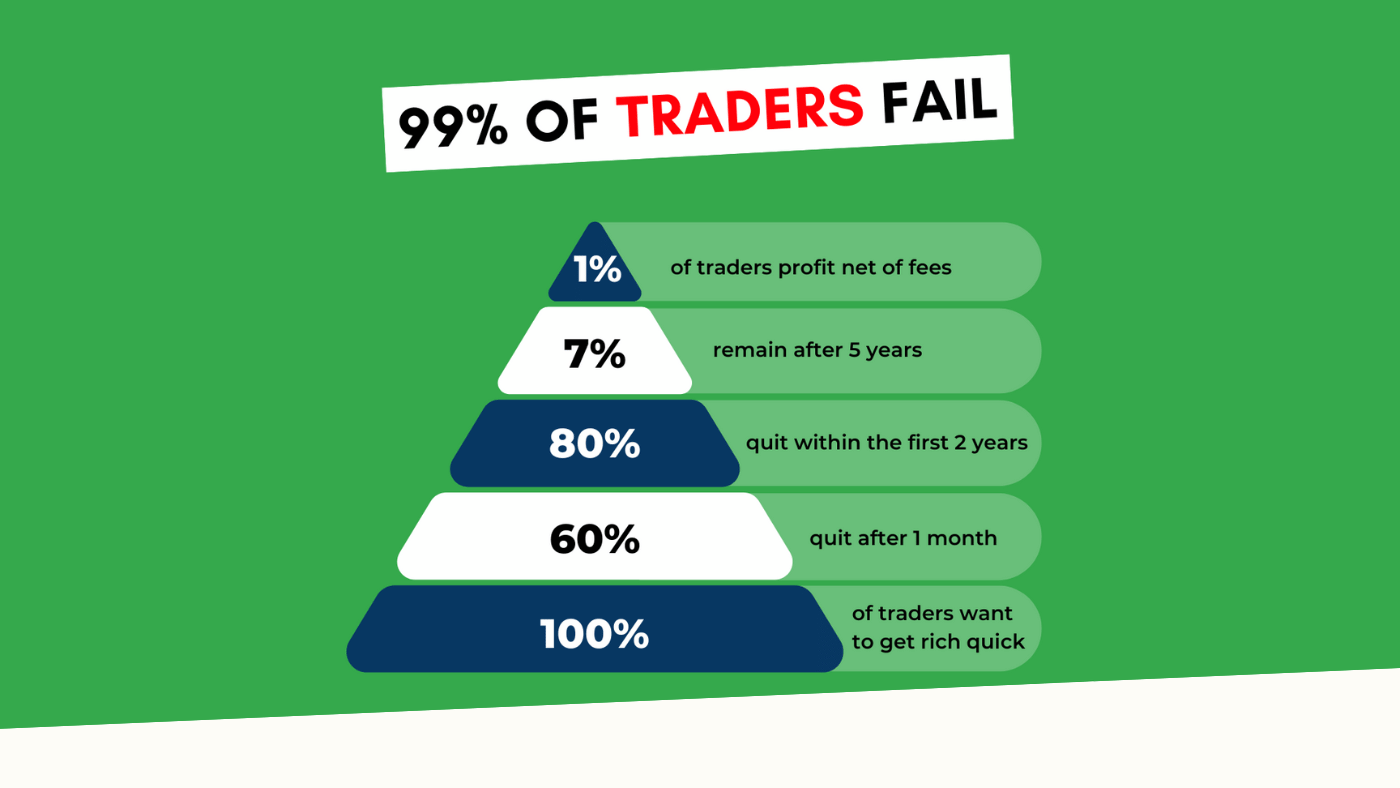
- 80% of all day merchants stop throughout the first two years. 1
- Amongst all day merchants, practically 40% day commerce for just one month. Inside three years, solely 13% proceed to day commerce. After 5 years, solely 7% stay. 1
- Merchants promote winners at a 50% larger fee than losers. 60% of gross sales are winners, whereas 40% of gross sales are losers.2
- The typical particular person investor underperforms a market index by 1.5% per 12 months. Energetic merchants underperform by 6.5% yearly. 3
- Day merchants with robust previous efficiency go on to earn robust returns sooner or later. Although solely about 1% of all day merchants are capable of predictably revenue web of charges. 1
- Merchants with as much as a ten years unfavorable observe report proceed to commerce. This means that day merchants even proceed to commerce after they obtain a unfavorable sign relating to their skill. 1
- Worthwhile day merchants make up a small proportion of all merchants – 1.6% within the common 12 months. Nevertheless, these day merchants are very lively – accounting for 12% of all day buying and selling exercise. 1
- Amongst all merchants, worthwhile merchants enhance their buying and selling greater than unprofitable day merchants. 1
- Poor people are inclined to spend a larger proportion of their revenue on lottery purchases and their demand for lottery will increase with a decline of their revenue. 4
- Buyers with a big differential between their current financial situations and their aspiration ranges maintain riskier shares of their portfolios. 4
- Males commerce greater than ladies. And single males commerce greater than married males. 5
- Poor, younger males, who reside in city areas and belong to particular minority teams make investments extra in shares with lottery-type options. 5
- Inside every revenue group, gamblers underperform non-gamblers. 4
- Buyers are inclined to promote profitable investments whereas holding on to their dropping investments. 6
- Buying and selling in Taiwan dropped by about 25% when a lottery was launched in April 2002. 7
- During times with unusually massive lottery jackpot, particular person investor buying and selling declines. 8
- Buyers usually tend to repurchase a inventory that they beforehand offered for a revenue than one beforehand offered for a loss. 9
- A rise in search frequency [in a specific instrument] predicts larger returns within the following two weeks. 10
- Particular person buyers commerce extra actively when their most up-to-date trades had been profitable.11
- Merchants don’t find out about buying and selling. “Buying and selling to be taught” isn’t any extra rational or worthwhile than enjoying roulette to be taught for the person investor.1
- The typical day dealer loses cash by a substantial margin after adjusting for transaction prices.
- [In Taiwan] the losses of particular person buyers are about 2% of GDP.
- Buyers chubby shares within the trade by which they’re employed.
- Merchants with a high-IQ have a tendency to carry extra mutual funds and bigger variety of shares. Subsequently, profit extra from diversification results.
Conclusion: Why Most Merchants Lose Cash Is Not Stunning Anymore
After going over these 24 statistics it’s very apparent to inform why merchants fail. Most of the time buying and selling selections will not be based mostly on sound analysis, examined buying and selling strategies or their buying and selling journal  , however on feelings, the necessity for leisure and the hope to make a fortune very quickly.
What merchants all the time neglect is that buying and selling is a occupation and requires abilities that must be developed through the years. Subsequently, be conscious of your buying and selling selections and the view you’ve gotten on buying and selling. Don’t anticipate to be a millionaire by the tip of the 12 months, however remember the chances buying and selling on-line has.
————
– 1Barber, Lee, Odean (2010): Do Day Merchants Rationally Be taught About Their Means?
– 2Odean (1998): Quantity, volatility, worth, and revenue when all merchants are above common
– 3Barber, & Odean (2000): Buying and selling is hazardous to your wealth: The frequent inventory funding efficiency of particular person buyers
– 4 Kumar: Who Gambles In The Inventory Market?
– 5 Barber, Odean (2001): Boys can be boys: Gender, overconfidence, and customary inventory funding
– 6Calvet, L. E., Campbell, J., & Sodini P. (2009). Battle or flight? Portfolio rebalancing by particular person buyers.
–7Barber, B. M., Lee, Y., Liu, Y., & Odean, T. (2009). Simply how a lot do particular person buyers lose by buying and selling?
– 8Gao, X., & Lin, T. (2011). Do particular person buyers commerce shares as playing? Proof from repeated pure experiments
– 9Strahilevitz, M., Odean, T., & Barber, B. (2011). As soon as burned, twice shy: How naïve studying, counterfactuals, and remorse have an effect on the repurchase of shares beforehand sol.
– 10Da, Z., Engelberg, J., & Gao, P. (2011). In quest of consideration
– 11De, S., Gondhi, N. R. & Pochiraju, B. (2010). Does signal matter greater than measurement? An investigation into the supply of investor overconfidence
